
Wool Dryer Balls vs Dryer Sheets: Which Actually Saves You More?
June 22, 2026
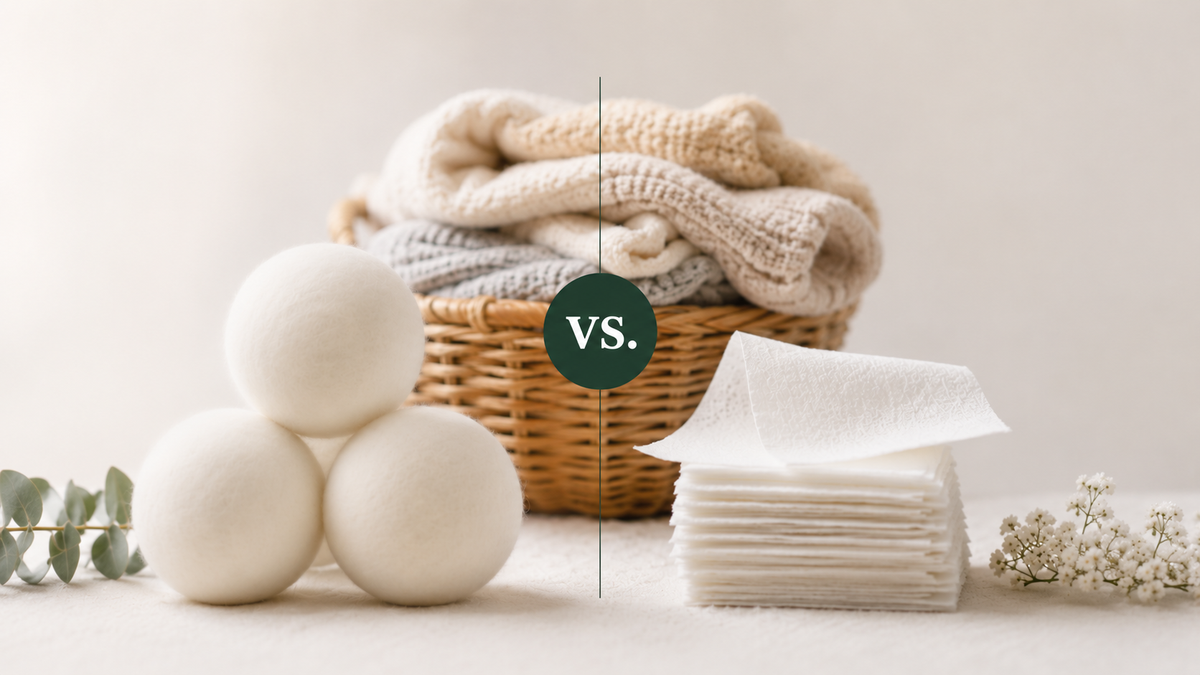
If you only remember one thing, remember this: for most households, wool dryer balls beat dryer sheets on cost, energy use, and what you put next to your skin. Dryer sheets only pull ahead if your top priority is maximum static zap and a strong synthetic fragrance. A good set of wool dryer balls is a single upfront cost, lasts roughly 1,000 loads (about 5 years), trims drying time by 14 to 25 percent, and leaves no chemical coating behind. Dryer sheets are cheap per box but single use, coat your fabrics in a thin wax, and head to the landfill after one cycle.
Wool wins for almost everyone.
Cheaper over time, faster drying, no chemicals, no waste. Keep dryer sheets only if you want heavy fragrance and maximum static control on synthetics. Here is the full head to head.
At a glance
| Factor | Wool dryer balls | Dryer sheets |
|---|---|---|
| Cost structure | One upfront purchase | Ongoing, you rebuy every box |
| Lifespan | About 1,000 loads (up to 5 years) | One load, then thrown away |
| Drying time | 14 to 25 percent faster | No meaningful change |
| Static control | Good, great with one quick trick | Excellent (chemical coating) |
| Softening | Mechanical, no residue | Chemical wax coating |
| Towel absorbency | Kept intact | Can reduce it over time |
| Fragrance and skin | Unscented, you control scent | Added synthetic fragrance |
| Eco impact | Reusable, biodegradable | Single use waste |
| Best for | Saving money, sensitive skin, big loads | Heavy fragrance, max static on synthetics |
How do wool dryer balls actually work?
Wool dryer balls are dense balls of compressed wool that you toss into the dryer with a wet load. They do three useful things at once. First, they bounce between your clothes and physically separate them, which lets hot air reach more fabric instead of getting trapped inside a wet, tangled clump. Second, the wool absorbs moisture, roughly 30 to 35 percent of its own weight, then releases it as steam that helps relax wrinkles. Third, that constant tumbling action softens fibers the natural way, by movement rather than by coating them in anything.
The payoff is faster drying. Independent tests have found wool dryer balls cut drying time by 14 to 25 percent, which for a typical American household with an electric dryer adds up to roughly $18 to $30 in energy savings per year. Size matters here too: a larger 4 inch ball has more surface area and displaces more space in the drum, so it moves more air and works harder on bulky loads like towels, sheets, and hoodies.


An extra inch of diameter and twice the material of standard balls, so they move more air, dry faster, and pummel bulky loads into soft, static-free submission. Chemical free, reusable for about 1,000 loads.
What do dryer sheets do?
Dryer sheets are thin, single use sheets coated in a mix of softening chemicals, lubricants, and fragrance. As the dryer heats up, that coating melts and transfers onto your clothes. The wax-like layer is what makes fabric feel slippery-soft and what neutralizes static, since it stops the friction that builds up a charge. They are genuinely good at killing static, especially on synthetic gym clothes, and they leave behind that familiar "fresh laundry" smell.
The trade offs show up over time. That same coating can build up on towels and athletic wear, reducing how well they absorb water and wick sweat. It can also leave residue on your dryer's lint screen, which restricts airflow. And because each sheet is used once and tossed, the cost and the waste keep adding up load after load. For anyone with sensitive skin, the synthetic fragrances and softening agents are a common source of irritation.

Wool dryer balls vs dryer sheets, head to head
The table above is the quick version. Here is what is really going on in each category that matters.
Cost over time
This is the clearest win for wool. A quality set of wool dryer balls is one purchase that lasts years. Dryer sheets cost less per box, but you buy them again and again. Over the roughly 1,000 loads one good set of balls covers, you would move through many boxes of sheets. The balls usually pay for themselves within the first few months, then keep saving you money every load after that.
Drying time and energy
Dryer sheets do nothing for drying speed. Wool dryer balls shorten it by 14 to 25 percent by improving airflow, which is also where the $18 to $30 a year in energy savings comes from. If you run a lot of laundry, that gap widens fast.
Softness and static
Here the two split. Dryer sheets win on raw static control because the chemical coating is very effective, and on a heavy synthetic load they still have a slight edge. Wool dryer balls soften mechanically and handle static well in most loads, and a simple trick (covered below) closes most of the gap without any chemicals.
Chemicals, skin, and the environment
If you want to avoid synthetic fragrance and softening chemicals, whether for sensitive skin, for babies, or just on principle, wool dryer balls are the obvious pick. They are unscented by default, so you decide if and how to add scent. They are also reusable and biodegradable, while dryer sheets are single use and end up in the trash.

So which should you choose?
For the large majority of households, wool dryer balls are the smarter long term choice. They cost less over time, cut your drying time and energy bill, keep chemicals off your skin and your towels, and create no waste. Choose dryer sheets only if your single biggest priority is the strongest possible static control on synthetic loads, or you specifically want that heavy added fragrance.
You can also have it both ways. Plenty of people run wool dryer balls for everyday loads and only reach for the damp-ball static trick (below) on the occasional synthetic-heavy load.
And yes, size matters
Most dryer balls are a measly 2.75 inches, basically lint with ambition. Our 4 inch balls are twice the material with well over an inch of extra diameter, so they move more air and make a real difference on towels, bedding, and bulky winter wear. Bigger really is better.

Ditch the dryer sheets for good. One set replaces years of single use sheets, with no chemical coating and faster drying on every load.
How to get the most from your wool dryer balls
A few simple habits get you the best softening, the fastest drying, and almost no static.

Want the deeper dive on the science and the studies behind these numbers? See our companion guide, how to use wool dryer balls. For independent background, the David Suzuki Foundation and appliance makers like Whirlpool both cover how they work.
Frequently asked questions
Do wool dryer balls really reduce drying time?
Yes. Independent tests put the reduction at 14 to 25 percent, because the balls separate your laundry and let hot air circulate more freely. For a typical electric dryer, that translates to roughly $18 to $30 in energy savings a year.
Are wool dryer balls better than dryer sheets for sensitive skin?
Generally, yes. Wool dryer balls are unscented and add no softening chemicals or synthetic fragrance, which are common irritants. Dryer sheets coat fabric in those very ingredients, so people with sensitive skin often prefer wool.
Do wool dryer balls control static as well as dryer sheets?
Dryer sheets have a slight edge on heavy synthetic loads because of their chemical coating. Wool dryer balls handle static well in most loads, and you can close the gap by lightly dampening a ball or not overdrying the load.
How many wool dryer balls should I use?
With 4 inch balls, use two for a regular load and four for a massive or bulky one like towels or bedding. With standard small balls you would need 5 or 6.
How long do wool dryer balls last?
A quality set lasts about 1,000 loads, or roughly 5 years of normal use. When they start to feel less effective, a quick wash cycle fluffs the wool and revives them.
Can I use wool dryer balls and dryer sheets together?
You can, but it partly defeats the purpose, since the sheet still adds the chemicals and waste you are trying to avoid. A better combo is wool balls for everyday loads plus the damp-ball trick when a synthetic load needs extra static control.
Ready to ditch the dryer sheets?
One set of Big Wool Balls replaces years of single use sheets, dries your laundry faster, and keeps the chemicals off your skin.
Get bigger balls on Amazon →Reusable for about 1,000 loads · Chemical free, naturally